Moving Average Crossover Strategy: The Only Rules That Matter
A moving average crossover isn’t a trade—it’s a regime detector. Here’s a rules-based crossover strategy with real SPY examples, entry zones, invalidation levels, and filters to reduce whipsaws.


Moving Average Crossover Strategy: The Only Rules That Matter

James Whitfield
Markets Desk Editor · Blue Ocean Trading Solutions
Moving average crossovers are one of the most overused signals in trading—and that’s exactly why most traders get chopped up by them. A crossover is not a prediction engine. It’s a regime detector. Used correctly, it keeps you on the right side of sustained trends. Used lazily, it turns your P&L into a collection of tiny paper cuts called “whipsaws.”
In this education piece I’m going to lay out a ruleset for a moving average crossover strategy that actually survives real markets: when to take the signal, when to ignore it, how to structure the entry so you’re not buying the very top, and how to define the one level that kills the thesis. We’ll use real SPY data (Oct 2025–Apr 2026) to show both the clean signal and the failure mode.
1) What a crossover is (and what it is not)
A fast moving average crossing a slow moving average is simply the market telling you: “the recent tape has started to outrun the longer-term tape.” That’s it. There’s no magic. It’s a smoothed way to identify whether momentum is shifting.
Here’s the practical translation:
- Bullish crossover (fast > slow): you stop looking for heroic shorts and start hunting pullbacks to buy.
- Bearish crossover (fast < slow): you stop buying dips by default and start treating bounces as potential short entries.
The problem is that most content stops here. It treats every cross as a trade. That’s a fast track to death-by-commissions.
The “lagging indicator” objection misses the point
Yes, crossovers are lagging. Good. You want confirmation when you’re trading trend continuation. The only time “leading” matters is when you’re trying to pick bottoms and tops—which is a great way to build a highlight reel of being wrong.
2) The core framework: trend filter + trigger + execution
If you’re serious about trading crossovers, stop treating it as one signal. Treat it as a three-part system:
- Trend filter: Are you allowed to be long or short?
- Trigger: What event flips the regime?
- Execution: Where do you enter so the trade has sane risk/reward?
My preferred crossover structure for liquid indices and ETFs is a 20/50 EMA (fast/slow) for the daily timeframe. It’s responsive enough to catch trend changes without firing every time the market sneezes. For investors and macro trend checks, the classic 50/200 (golden cross / death cross) still matters—but it’s slow by design.
3) Real-market example: SPY (Oct 2025–Apr 2026) shows both sides
Let’s put numbers to it. Over the last six months of this window, SPY printed a bullish 20/50 EMA cross on 2025-11-28 with SPY closing around $683.39. Later, the tape flipped bearish with a 20/50 cross down on 2026-03-06 with SPY closing around $672.38. Those dates matter because they anchor the “regime” call in something objective.
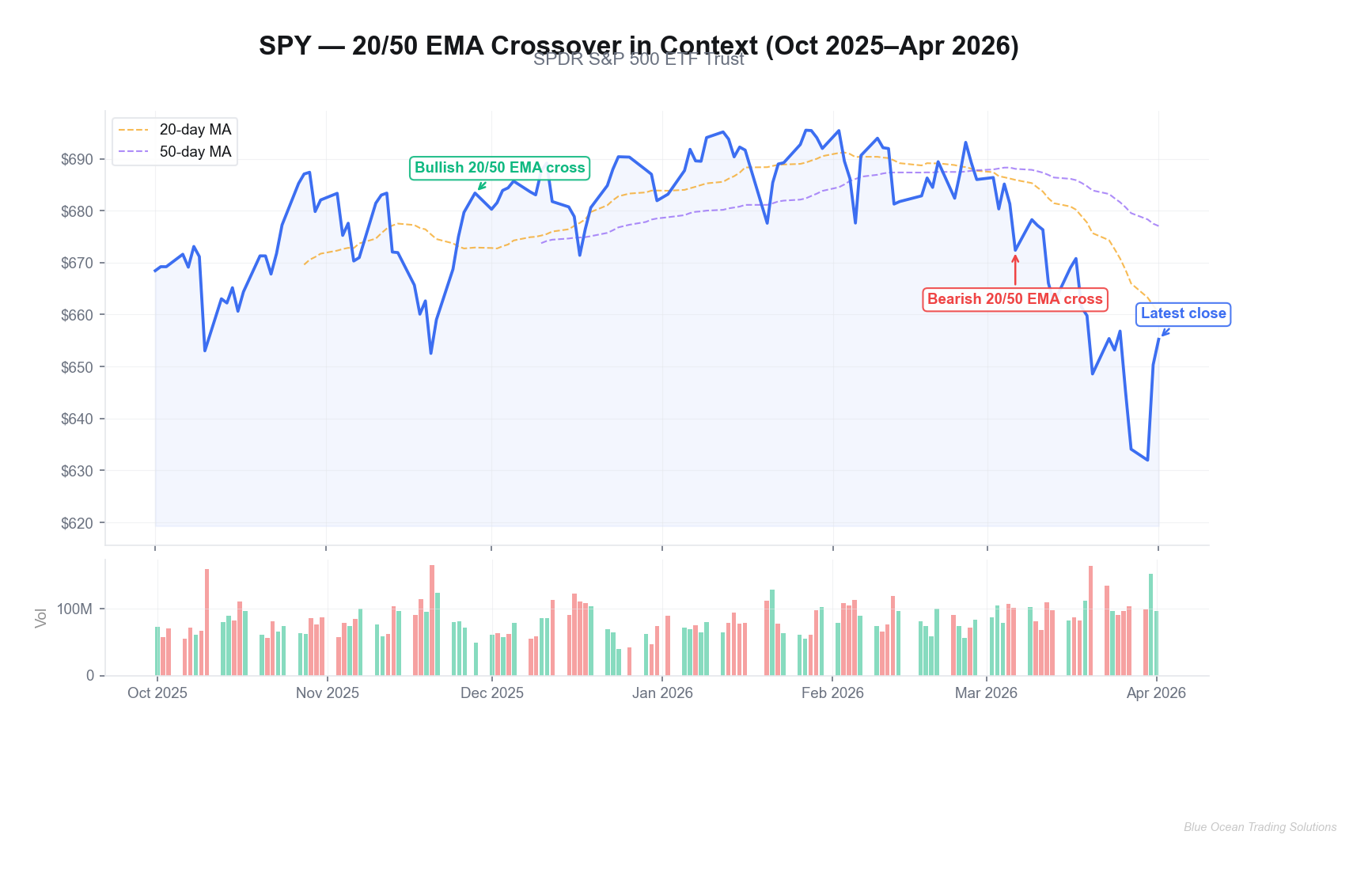
Notice what the chart is really saying: the crossover didn’t give you the high. It gave you permission to keep leaning with the prevailing direction until proven otherwise.
So what’s the trade?
The trade is not “buy the instant the lines cross.” The trade is:
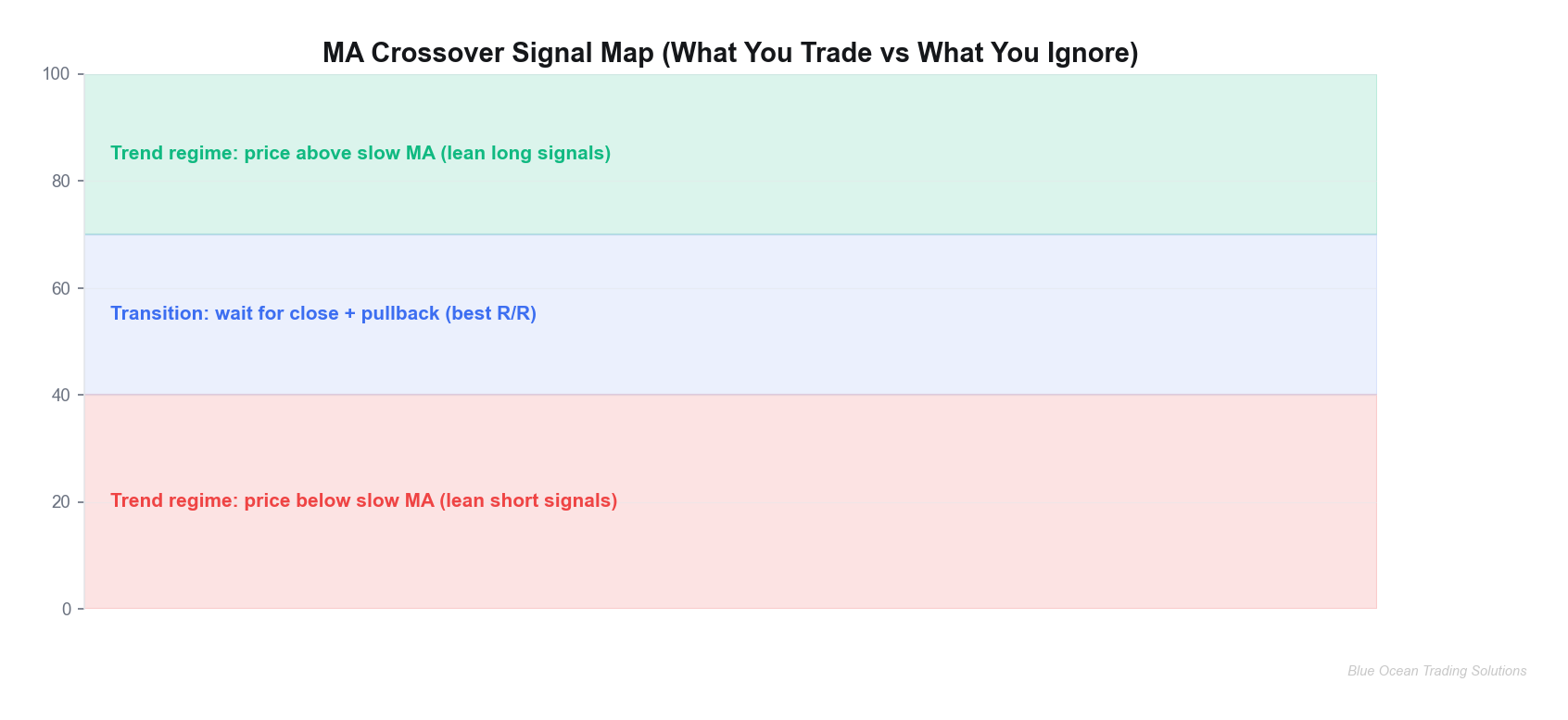
- Entry zone: buy the first pullback toward the fast average after the bullish cross as long as price stays above the slow average.
- Invalidation: a daily close back under the slow MA (or under the most recent swing low) kills the long thesis.
- Targets: prior swing highs and weekly structure—your upside has to be larger than your defined risk or you’re just donating volatility.
On the short side, flip the logic. After a bearish cross, you want rallies into resistance—ideally into the fast MA—with the slow MA acting like the line in the sand. That’s where the risk/reward profile actually favors shorts.
4) The whipsaw problem—and three filters that actually help
Whipsaws happen when the market is range-bound. Crossovers are trend-following tools, so if there is no trend, the system will repeatedly “detect” trends that don’t exist.
Here are three filters that reduce false signals without turning the strategy into a science project:
Filter #1: Only trade crossovers in the direction of the bigger trend
At Blue Ocean, we anchor structure with the 20-week EMA. If SPY is below the 20-week and the 20-week is rolling over, bullish daily crossovers are low-conviction. You’re trading counter-trend bounces, not trend continuation. That’s fine—as long as you size it like a counter-trend trade and take profits faster.
Filter #2: Require a close, not an intraday tag
The easiest way to get faked out is to trade an intraday cross. Require the candle to close with the fast MA clearly above/below the slow MA. If you’re impatient, the market will happily charge you tuition.
Filter #3: Use momentum context (RSI as a sanity check)
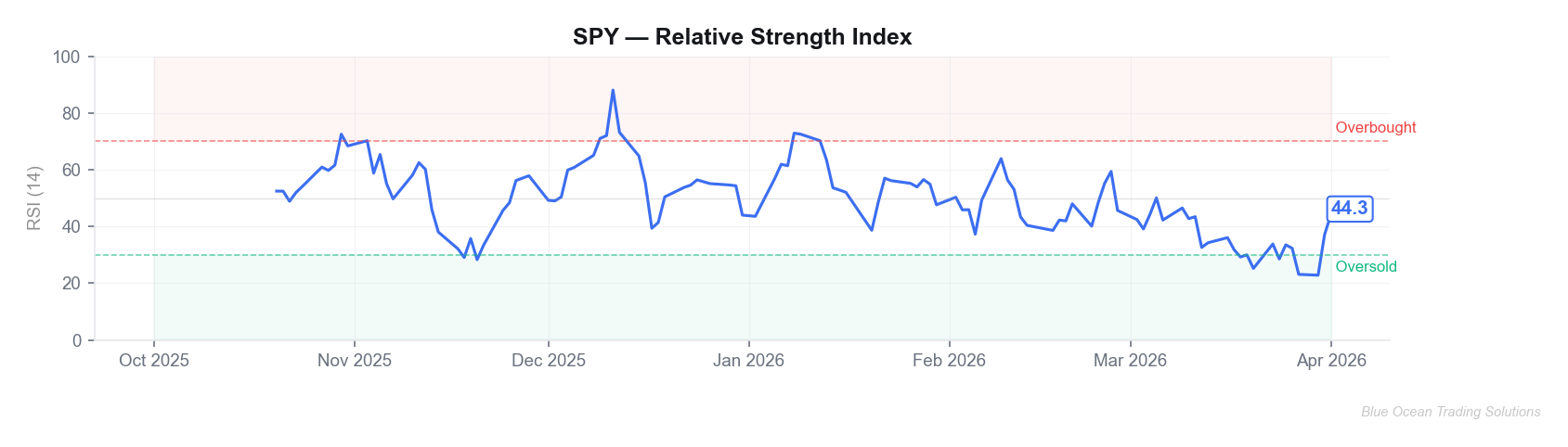
I’m not asking you to worship RSI. I’m asking you to use it to avoid the dumbest version of the trade. If you get a fresh bullish cross but RSI is already stretched and rolling over, your best entry is usually not “right now.” It’s after the first pullback. Conversely, in bearish regimes, RSI failing to reclaim the midline often aligns with lower highs and shortable bounces.
5) Execution rules: entries, stops, targets (the part that determines your P&L)
Crossovers tell you directional bias. Execution tells you whether the trade is mathematically worth taking.
Long setup checklist (after a bullish cross)
- Price above slow MA (trend filter passes).
- First pullback toward fast MA or a clean daily swing level.
- Entry on a reversal day (higher low / strong close), not on a red waterfall candle.
- Stop below the pullback low or below a “self-cleaning” swing level (once price closes through it, it’s removed as support).
- Target at prior highs / weekly swing resistance. If you can’t get at least ~2R, skip it.
Short setup checklist (after a bearish cross)
- Price below slow MA (trend filter passes).
- Rally into fast MA or into broken support acting as resistance.
- Entry on failure (lower high, weak bounce, rejection day).
- Stop above the rally high or above the slow MA (the thesis is dead if price reclaims it).
- Target at prior lows / weekly support. Again: if you can’t see the 2R, don’t force it.
These rules do two things: they reduce overtrading, and they keep your losses small when the tape is choppy. In crossover systems, your big winners pay for a lot of scratches. Your job is to make sure scratches stay scratches.
6) Putting it together: a trader’s playbook (and a final warning)
The cleanest way to use a moving average crossover is to treat it like a permission slip:
- Regime: bullish or bearish?
- Location: are you entering at a level where risk is defined?
- Risk: what price proves you wrong?
If you do that, a crossover system becomes a durable way to stay aligned with trends while avoiding the worst emotional mistakes: chasing highs, averaging down losers, and inventing narratives after the fact.
If you want to see how we connect structure (weekly) and execution (daily) into one repeatable process, download the free Two-Timeframe Edge guide here: blueoceantradingsolutions.com/free-guide/.
Disclaimer: This article is for educational purposes only and does not constitute investment advice. Trading involves risk, including the possible loss of principal. Past performance is not indicative of future results.